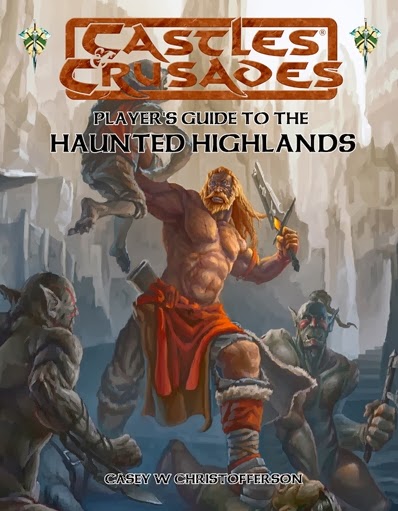
Got word back a bit earlier today that some of those issue I had pointed out (notably with the Player's Guide) have been corrected. Updated versions of the PDF are now available if you already have them.
Haven't read either of my reviews yet?
You can find my review for the Player's Guide to the Haunted Highlands HERE.
You can find my review for the Castle Keeper's Guide to the Haunted Highlands HERE.
Didn't back but are interested in the PDFs? You can by them HERE.
Lastly, feel a bit bummed about missing out on TLG's last Kickstarter? There is a new one going on right now over HERE.
M
Friday, February 7, 2014
Weekend R&R: Castle Keeper's Guide to the Haunted Highlands (C&C)
Last summer, Troll Lord Games launched a Kickstarter to promote the Haunted Highlands, an adventure setting for the Castles & Crusades RPG. The brainchild of Casey Christofferson, the Haunted Highlands started off as a series of adventure modules published a few years for C&C, these have been pulled together along with an accessory called the Black Libram to from a portion of the two books to come out of this Kickstarter. These are the Player's Guide to the Haunted Highlands and the Castle Keeper's Guide to the Haunted Highlands.
The Castle Keeper's Guide to the Haunted Highlands
The Return to the Haunted Highlands Kickstarter was TLG's most successful fundraising campaign to date and this book is the jewel of this project. Years ago, as the original modules were being released, there was talk about expanded the setting introduced through Chritofferson's writings. When TLG published the Eastmark Gazetteer and the After Winters Dark folios, fans clamored for a Haunted Highlands folio. Admittedly, I also thought it would have been a great idea at the time. Then, the conversation turned to the idea of a Haunted Highlands boxed set, much like those classic setting boxed sets published by TSR in days long past. Box sets are cool after all. Somehow, the Highlands got put aside as other projects demanded a greater measure of attention until (pretty much) the Kickstarter itself -- the goal of which was to, as many felt, give the Haunted Highlands the treatment it deserved.
If I were to describe this book to others, it's a wonderful beast of a book. The Haunted Highlands is a gritter setting than some people may be accustomed to and what started off as a micro-setting being pieced together by the release of adventure modules has evolved into something greater. The Haunted Highlands also gave way to the Free City of Eskadia (I review it HERE) which is now part of a larger whole. The book is complete with a gazetteer component, a section of deities and fiends, previously published adventures DB1 - DB6 which have been updated and expanded, the addition of three more adventures (DB7 - DB9), and a bestiary section. This mammoth book is 400 pages!
The first section, the gazetteer, gives a nice overview of the setting but remains true to the concept of what a gazetteer should be -- entries are numerous but short and concise. However, between these entries and the supplied, a clear enough picture is presented and, given that the majority of the book is an assembled collection of 9 adventures, many things covered in the gazetteer will be visited in the adventures as well. This will certainly help to create a lasting impression upon the players participating and playing through the campaign. Of course, in a land of myth and magic where gods and demons vie for influence, a good fantasy setting would be incomplete if this was ignored. These really help add flavor to the setting and provides further inspiration to draw from when painting a narrative for the players to immerse themselves in.
The second, and by far, the largest section is the collection of adventures for the Haunted Highlands. It is important to note that most of this material can be used as needed, or which ever path the players dare to tread. There is nothing that forces the players to start and go on advancing through the modules one at a time starting off at DB1 through DB9. In the first of these, goes on to describe the areas in DB1 as:
On the subject of the adventuring material presented, the only thing I wish that could have been added in is some sort of mass-combat rules to go along with the large combat scenarios which started to be presented from DB4 and onward. When DB4: Dro Mandras was first published, the module had alluded to the 'Tides of Battle' system for Mass Combat. Fields of Battle was published sometime afterwards and a condensed version of the rules appeared in the Castle Keeper's Guide. I would have loved to see the inclusion of the condensed rules in either this volume or the Player's Guide to the Haunted Highland. Of course, the present book is already 400 pages...
The completely new content serves to broaden and link up other previously mentioned material but follow the same kind of format previously established. All in all, the 9 adventures along with the gazetteer really shines in this manner of presentation. To make the book complete, the last section is a sizable addition of another 70 pages of monsters for the C&C game. Of course, some of these are not entirely new having been previously published in the original six Haunted Highlands adventures but it's always nice to have these all in one place. Some of these creatures will also be familiar outside of C&C as many are conversions of the creatures made available through Necromancer Games' Tome of Horrors.
Compared to the Player's Guide, this book seems to have gotten the lion's share of attention where this project was concerned. There are, simply put, fewer problems as far as layout out and editing is concerned though these are still present. One thing is certain, I found them less intrusive over all. Any of these issues here may be more a layout issue than an editing one. An example of a layout issue can be found on the map spread on pages 234 - 235 of the book -- the header on the top of page 235 is obscured which leads me to believe it should not have been there.
Overall, I highly recommend this book and value it far more than the player's guide. The player's guide, though nice, isn't strictly necessary to enjoy the Haunted Highlands. The Castle Keeper's Guide to the Haunted Highlands is, on the other hand, a great way to kick off a new campaign in a slightly different setting that has a strong, swords and sorcery vibe to it. Take a trip down the Bowbe's Roadhouse and have yourself a pint... new adventures await for you!
As I mentioned before, the MSRP for the book, once released will be $40.00 but, if you prefer or like the idea of a digital alternative, consider the PDF available HERE for $27.99.
M
The Castle Keeper's Guide to the Haunted Highlands
The Return to the Haunted Highlands Kickstarter was TLG's most successful fundraising campaign to date and this book is the jewel of this project. Years ago, as the original modules were being released, there was talk about expanded the setting introduced through Chritofferson's writings. When TLG published the Eastmark Gazetteer and the After Winters Dark folios, fans clamored for a Haunted Highlands folio. Admittedly, I also thought it would have been a great idea at the time. Then, the conversation turned to the idea of a Haunted Highlands boxed set, much like those classic setting boxed sets published by TSR in days long past. Box sets are cool after all. Somehow, the Highlands got put aside as other projects demanded a greater measure of attention until (pretty much) the Kickstarter itself -- the goal of which was to, as many felt, give the Haunted Highlands the treatment it deserved.
If I were to describe this book to others, it's a wonderful beast of a book. The Haunted Highlands is a gritter setting than some people may be accustomed to and what started off as a micro-setting being pieced together by the release of adventure modules has evolved into something greater. The Haunted Highlands also gave way to the Free City of Eskadia (I review it HERE) which is now part of a larger whole. The book is complete with a gazetteer component, a section of deities and fiends, previously published adventures DB1 - DB6 which have been updated and expanded, the addition of three more adventures (DB7 - DB9), and a bestiary section. This mammoth book is 400 pages!
The first section, the gazetteer, gives a nice overview of the setting but remains true to the concept of what a gazetteer should be -- entries are numerous but short and concise. However, between these entries and the supplied, a clear enough picture is presented and, given that the majority of the book is an assembled collection of 9 adventures, many things covered in the gazetteer will be visited in the adventures as well. This will certainly help to create a lasting impression upon the players participating and playing through the campaign. Of course, in a land of myth and magic where gods and demons vie for influence, a good fantasy setting would be incomplete if this was ignored. These really help add flavor to the setting and provides further inspiration to draw from when painting a narrative for the players to immerse themselves in.
The second, and by far, the largest section is the collection of adventures for the Haunted Highlands. It is important to note that most of this material can be used as needed, or which ever path the players dare to tread. There is nothing that forces the players to start and go on advancing through the modules one at a time starting off at DB1 through DB9. In the first of these, goes on to describe the areas in DB1 as:
... not listed under a level of difficulty for their use. The areas of adventure detailed herein may be considered to be fluid and every-changing based on your style of play, thus handicapping them with level adjustments would proved foolish at best.It continues to state:
Certainly a hydra's lair may prove too difficult for low level characters, but may be though of as "just right" for higher level play. Likewise, a warren of goblins may be considered too easy a challenge for higher level adventuring hands, but just right for low level parties looking to cut their teeth on high adventure.In other words, the material is truly an assortment and much of it can be described in a similar way and it feels much more open ended than other published adventures.
On the subject of the adventuring material presented, the only thing I wish that could have been added in is some sort of mass-combat rules to go along with the large combat scenarios which started to be presented from DB4 and onward. When DB4: Dro Mandras was first published, the module had alluded to the 'Tides of Battle' system for Mass Combat. Fields of Battle was published sometime afterwards and a condensed version of the rules appeared in the Castle Keeper's Guide. I would have loved to see the inclusion of the condensed rules in either this volume or the Player's Guide to the Haunted Highland. Of course, the present book is already 400 pages...
The completely new content serves to broaden and link up other previously mentioned material but follow the same kind of format previously established. All in all, the 9 adventures along with the gazetteer really shines in this manner of presentation. To make the book complete, the last section is a sizable addition of another 70 pages of monsters for the C&C game. Of course, some of these are not entirely new having been previously published in the original six Haunted Highlands adventures but it's always nice to have these all in one place. Some of these creatures will also be familiar outside of C&C as many are conversions of the creatures made available through Necromancer Games' Tome of Horrors.
Compared to the Player's Guide, this book seems to have gotten the lion's share of attention where this project was concerned. There are, simply put, fewer problems as far as layout out and editing is concerned though these are still present. One thing is certain, I found them less intrusive over all. Any of these issues here may be more a layout issue than an editing one. An example of a layout issue can be found on the map spread on pages 234 - 235 of the book -- the header on the top of page 235 is obscured which leads me to believe it should not have been there.
Overall, I highly recommend this book and value it far more than the player's guide. The player's guide, though nice, isn't strictly necessary to enjoy the Haunted Highlands. The Castle Keeper's Guide to the Haunted Highlands is, on the other hand, a great way to kick off a new campaign in a slightly different setting that has a strong, swords and sorcery vibe to it. Take a trip down the Bowbe's Roadhouse and have yourself a pint... new adventures await for you!
As I mentioned before, the MSRP for the book, once released will be $40.00 but, if you prefer or like the idea of a digital alternative, consider the PDF available HERE for $27.99.
M
Thursday, February 6, 2014
Weekend R&R: Player's Guide to the Haunted Highlands (C&C)
Last summer, Troll Lord Games launched a Kickstarter to promote the Haunted Highlands, an adventure setting for the Castles & Crusades RPG. The brainchild of Casey Christofferson, the Haunted Highlands started off as a series of adventure modules published a few years for C&C, these have been pulled together along with an accessory called the Black Libram to from a portion of the two books to come out of this Kickstarter. These are the Player's Guide to the Haunted Highlands and the Castle Keeper's Guide to the Haunted Highlands.
The Player's Guide to the Haunted Highlands
The book is a modest, 112 page book which basically gives an overview of the new races, new classes, and variants available in the setting as well as basic information about the Highlands. In fact the first 28 pages is dedicated to the setting and the system specific 'crunch' doesn't begin to happen doesn't start before page 36.
The remainder of the book is clearly divided into 4 chapters though a 5th would have been warranted (and may possibly have been intended). These are 'Creating the Character', 'Races of Karbosk', 'Character Classes', and 'Dual Classing'.
The first chapter after the overview is on 'Creating the Character' but this a bit of a misnomer. Sure, it starts off by telling the would-be player to select their class, roll their attributes, and so on but most of the content of this chapter is devoted to an explanation of the attributes, the Siege Engine mechanic and how attribute checks, saving throws, and then how combat works. The chapter goes so far to go into situational modifiers, combat maneuvers, and even other odds and ends such as Spell Resistance and Turning Undead. This isn't a bad thing but none of this content is new; it's lifted straight out of the C&C PHB. When I first heard that this material was going to be in the book, I had hoped that the Player's Guide would be 'self-sufficient' after a fashion. I supposed it could be if you restricted yourself to the new races and classes there were in this book only. That would also mean restricting yourself to the new spells listed here too. However, given what's actually available to play in this book, the inclusion of this material doesn't make much sense, but who knows.
On the subject of races and classes, the second chapter covers what you need to play Orcs, Goblins, Hobgoblins, Dark Dwarves (the Zvarguth), and Meshkuri. Given the typical nature of these races in your typical game, these may be atypical of the sort players would find themselves playing. More often than not, I imagine it's the person who is running the game that tends to veto such an idea. The Highlands are a bit darker and certainly harsher so these selections may not be so odd given the setting. Variety is always interesting and most C&C fans will find these a welcome or at least interesting addition to the game.
Chapter 3 is all about new classes though in this section, two of the classes were previously published. The first of these is the Conjurer which originally appeared in DB6 -Dwellers in the Dark. Since these modules were being reprinted together in the CK Guide to the Haunted Highlands, it only makes sense to put it here. The second of these is the Necromancer which appeared in the Black Libram of Natarus. It's worth noting that the entirety of this accessory (now out of print) can be found in the pages of these two new Haunted Highland books. Also included is a different and tougher Assassin class, a Witch class, as well as other class variants.
Of interest to many C&C players who have their roots in older editions of D&D will be the rules provided for Dual Class characters. In principal, the rules supplied are almost adequate though I find myself disagreeing with a couple of points. Simply put and as I understand it, it's broken.
EDIT - I should point out that this is only my opinion and the following examples I provide are a bit extreme to illustrate a point given my understanding ... By no means does this mean it's unusable and I'm sure it would be fine in regular play.
Take what the author outlines for Base-to-Hit progression for example. The argument is that you don't 'forget' how to fight and improvement and training in an on-going thing. Any new BtH bonus acquired in the new class is gained as a result. At first glance, this might make sense. However, suppose a high level Fighter (say 10th) decides to become a Bard. Once his apprenticeship is done with, he can begin advancing in his new class. Keep in mind that the apprenticeship is half the requirement to reach level two in the new class. If the average XP needed for the party is about 250,000 to reach level 11, the player who changed class to a Bard who decides to focus on advancing this class only can advance to level 9 as a Bard and effectively be a 19th level character when the rest of the party is 11th. His BtH would be a 18 compared to the 11 of an 11th level fighter.
The other issue is nothing definite is given on the subject of Hit Dice and hit points except that you advance in the new class normally. Does this mean that, after rolling 10d10 for hitpoints for those 10 levels of fighter taken, you would then keep on rolling d10 for every level of Bard taken (since you roll up to and including level 10 of any given class)? Compare 19d10 vs the 11d10 of that simply 11th level fighter who has the same amount of XP.
It's problematic though it could easily be fixed. Since other class abilities and skills are constrained by the class level itself (and not total level), the same MUST be done with the BtH bonus. Total HD also need to be limited -- only 10 dice worth can be rolled up for HP and any HP gained after 10 HD is determined by the class the character advanced in. I suppose that's the easiest way to fix it though Dual Classing in general is far from elegant in a variable XP/Class system.
Sadly, the book's organization becomes a bit muddled after the Dual Classing. Chapter 4 seemingly continues into magic which, once again, is a repeat of material found in the PHB followed by new spells and a small section on sacrificial magic which were both originally found in the Black Libram.
It really seems like this last magic section should have been it's own chapter but somehow, it got lost in the editing and layout process. On the subject of editing, along with some of the other things I have seen in this book, it does feel that it was rushed in parts of it. In the first few pages when I stopped to examine a passage, I found a number of little issues. I think some of these have to do with the parts of the text that were ported (copied and pasted) into the present book. In passages that exist in the PHB, I have seen words 'thrust together' because of missing spaces in this book. On the same page, I've seen another example of sentence starting off with the first word going uncapitalized. These are very minor things but, it does give me pause to see several example of this on a single page of text that already exists in another book. For those curious, please take a good look at the numbered page 41 of the book. It is entirely possible that some of these 'space' issues are due to the program used for the layout of the book, or perhaps it was a slightly older version of the text that was used here.
Overall, I like the book and the companion CK book that comes with it (to be reviewed tomorrow, time permitting) looks to be great. The book is far from perfect but perhaps it was the fact that a lot of the text in this book was seen before which led to a bit more complacency with regards to the integrity of the book. Being the responsible sort that I am, I will attempt to point a few of these things out to the powers that be. It hasn't gone to press yet so maybe a few of these things can be tweaked and the PDF updated.
For those wanting to grab a copy, it is available now (warts and all) at RPGNow over HERE. It is priced as a MSRP of $13.99 (cover price for the hardback will be $19.99 when available).
The Player's Guide to the Haunted Highlands
The book is a modest, 112 page book which basically gives an overview of the new races, new classes, and variants available in the setting as well as basic information about the Highlands. In fact the first 28 pages is dedicated to the setting and the system specific 'crunch' doesn't begin to happen doesn't start before page 36.
The remainder of the book is clearly divided into 4 chapters though a 5th would have been warranted (and may possibly have been intended). These are 'Creating the Character', 'Races of Karbosk', 'Character Classes', and 'Dual Classing'.
The first chapter after the overview is on 'Creating the Character' but this a bit of a misnomer. Sure, it starts off by telling the would-be player to select their class, roll their attributes, and so on but most of the content of this chapter is devoted to an explanation of the attributes, the Siege Engine mechanic and how attribute checks, saving throws, and then how combat works. The chapter goes so far to go into situational modifiers, combat maneuvers, and even other odds and ends such as Spell Resistance and Turning Undead. This isn't a bad thing but none of this content is new; it's lifted straight out of the C&C PHB. When I first heard that this material was going to be in the book, I had hoped that the Player's Guide would be 'self-sufficient' after a fashion. I supposed it could be if you restricted yourself to the new races and classes there were in this book only. That would also mean restricting yourself to the new spells listed here too. However, given what's actually available to play in this book, the inclusion of this material doesn't make much sense, but who knows.
On the subject of races and classes, the second chapter covers what you need to play Orcs, Goblins, Hobgoblins, Dark Dwarves (the Zvarguth), and Meshkuri. Given the typical nature of these races in your typical game, these may be atypical of the sort players would find themselves playing. More often than not, I imagine it's the person who is running the game that tends to veto such an idea. The Highlands are a bit darker and certainly harsher so these selections may not be so odd given the setting. Variety is always interesting and most C&C fans will find these a welcome or at least interesting addition to the game.
Chapter 3 is all about new classes though in this section, two of the classes were previously published. The first of these is the Conjurer which originally appeared in DB6 -Dwellers in the Dark. Since these modules were being reprinted together in the CK Guide to the Haunted Highlands, it only makes sense to put it here. The second of these is the Necromancer which appeared in the Black Libram of Natarus. It's worth noting that the entirety of this accessory (now out of print) can be found in the pages of these two new Haunted Highland books. Also included is a different and tougher Assassin class, a Witch class, as well as other class variants.
Of interest to many C&C players who have their roots in older editions of D&D will be the rules provided for Dual Class characters. In principal, the rules supplied are almost adequate though I find myself disagreeing with a couple of points. Simply put and as I understand it, it's broken.
EDIT - I should point out that this is only my opinion and the following examples I provide are a bit extreme to illustrate a point given my understanding ... By no means does this mean it's unusable and I'm sure it would be fine in regular play.
Take what the author outlines for Base-to-Hit progression for example. The argument is that you don't 'forget' how to fight and improvement and training in an on-going thing. Any new BtH bonus acquired in the new class is gained as a result. At first glance, this might make sense. However, suppose a high level Fighter (say 10th) decides to become a Bard. Once his apprenticeship is done with, he can begin advancing in his new class. Keep in mind that the apprenticeship is half the requirement to reach level two in the new class. If the average XP needed for the party is about 250,000 to reach level 11, the player who changed class to a Bard who decides to focus on advancing this class only can advance to level 9 as a Bard and effectively be a 19th level character when the rest of the party is 11th. His BtH would be a 18 compared to the 11 of an 11th level fighter.
The other issue is nothing definite is given on the subject of Hit Dice and hit points except that you advance in the new class normally. Does this mean that, after rolling 10d10 for hitpoints for those 10 levels of fighter taken, you would then keep on rolling d10 for every level of Bard taken (since you roll up to and including level 10 of any given class)? Compare 19d10 vs the 11d10 of that simply 11th level fighter who has the same amount of XP.
It's problematic though it could easily be fixed. Since other class abilities and skills are constrained by the class level itself (and not total level), the same MUST be done with the BtH bonus. Total HD also need to be limited -- only 10 dice worth can be rolled up for HP and any HP gained after 10 HD is determined by the class the character advanced in. I suppose that's the easiest way to fix it though Dual Classing in general is far from elegant in a variable XP/Class system.
Sadly, the book's organization becomes a bit muddled after the Dual Classing. Chapter 4 seemingly continues into magic which, once again, is a repeat of material found in the PHB followed by new spells and a small section on sacrificial magic which were both originally found in the Black Libram.
It really seems like this last magic section should have been it's own chapter but somehow, it got lost in the editing and layout process. On the subject of editing, along with some of the other things I have seen in this book, it does feel that it was rushed in parts of it. In the first few pages when I stopped to examine a passage, I found a number of little issues. I think some of these have to do with the parts of the text that were ported (copied and pasted) into the present book. In passages that exist in the PHB, I have seen words 'thrust together' because of missing spaces in this book. On the same page, I've seen another example of sentence starting off with the first word going uncapitalized. These are very minor things but, it does give me pause to see several example of this on a single page of text that already exists in another book. For those curious, please take a good look at the numbered page 41 of the book. It is entirely possible that some of these 'space' issues are due to the program used for the layout of the book, or perhaps it was a slightly older version of the text that was used here.
Overall, I like the book and the companion CK book that comes with it (to be reviewed tomorrow, time permitting) looks to be great. The book is far from perfect but perhaps it was the fact that a lot of the text in this book was seen before which led to a bit more complacency with regards to the integrity of the book. Being the responsible sort that I am, I will attempt to point a few of these things out to the powers that be. It hasn't gone to press yet so maybe a few of these things can be tweaked and the PDF updated.
For those wanting to grab a copy, it is available now (warts and all) at RPGNow over HERE. It is priced as a MSRP of $13.99 (cover price for the hardback will be $19.99 when available).
Tuesday, February 4, 2014
SALE - Wilderlands of High Fantasy Bundle
Here's the deal folks. About once or twice a year, I try and clear some room from my bookshelves selecting a few items here and there that I see about offering up for sale. The money that comes in helps with the bills as well as fund aspects of a new project or other expenses that Arcana Creations incurs.
I've decided to dig a bit deeper and I have a bundle set up that almost pains me to part with. Then again, it also pains me that I am just not using the stuff despite how excellent these truly are. So, for a LIMITED TIME only, I have decided to offer up for sale as a bundle the following:
Interested? I am asking $225.00 USD for the lot. This includes shipping to anywhere in Canada or the continental United States. If living abroad and you are genuinely interested, please contact me and we will examine the possibility. Payments will be Paypal only for this. I can be reached at:
patbellavance (at) sympatico (dot) ca
Feel free to ask me questions and know that payment and address confirmation will be handled subsequently.
One last but IMPORTANT detail. As indicated, this is a LIMITED time offer. As much as I would be happy to sell these, part of me would be equally happy to hold on to these. This offer will EXPIRE on February 28th, 2014 at midnight (EST) where it will be rescinded. Anyone who knows the value and quality of these books won't blame me for that, I am sure. ;)
M
I've decided to dig a bit deeper and I have a bundle set up that almost pains me to part with. Then again, it also pains me that I am just not using the stuff despite how excellent these truly are. So, for a LIMITED TIME only, I have decided to offer up for sale as a bundle the following:
- Wilderlands of High Fantasy (d20) box set
- City State of the Invincible Overlord (d20) hardcover
- Players Guide to the Wilderlands (d20) softcover
- Caverns of Thracia (d20) softcover
- JG1 - Thieves of Fortress Badabaskor (d20) softcover
- JG2 - Citadel of Fire (d20) softcover
- JG3 - Dark Tower (d20) softcover
Interested? I am asking $225.00 USD for the lot. This includes shipping to anywhere in Canada or the continental United States. If living abroad and you are genuinely interested, please contact me and we will examine the possibility. Payments will be Paypal only for this. I can be reached at:
patbellavance (at) sympatico (dot) ca
Feel free to ask me questions and know that payment and address confirmation will be handled subsequently.
One last but IMPORTANT detail. As indicated, this is a LIMITED time offer. As much as I would be happy to sell these, part of me would be equally happy to hold on to these. This offer will EXPIRE on February 28th, 2014 at midnight (EST) where it will be rescinded. Anyone who knows the value and quality of these books won't blame me for that, I am sure. ;)
M
Monday, February 3, 2014
SOS - Gateway Boardgames
Originally published on Sound on Sight:
Gaming can mean different things for different people and some are more inclined to engage in these activities than others. The rise in popularity of video games led them to grow beyond the boundaries of an arcade to our very homes through our computers and our video game consoles. We are, by our very nature, social beings and much of our gaming habits involve playing with other people as either teammates or opponents. But before the prominence and accessibility to video games, we still found ways to play games and amuse ourselves. Some of us may have been inclined to leave the concept of a board game behind us, thinking them nothing more than the likes of Sorry, Battleship, or Checkers. Or, worse yet, you are a gamer and already know the reality of things but friends will be quick to remind you why they don’t play such games anymore after that one terrible experience with Monopoly that lasted for hours.
Board games are very much alive and well despite the digital generation we are currently a part of. There are vast numbers of games available and many of them are easy to learn, simple to play, and offer a rewarding way to spend time with friends or family which doesn't involve sitting in front of a television screen or computer monitor. It might be that you need to find the ‘right type’ of game to ease the ‘non-gamer’ into playing something not overly complex and long. Maybe you just want to try and get that significant other to try and share one of your interests instead of having them run away screaming.
What you need in this situation is a ‘Gateway Game’.
The term is shamelessly inspired by the idea of a ‘gateway drug’… In other words, these are games that ease you into a gaming culture where you might become more open to at least understand the passion that some gamers have and hopefully share some great and fun experiences with them. While I would recommend any of these games as starting points, these games are also different enough from each other. It’s worth comparing these and picking one that is better suited to the people you have in mind for the game.
Ticket to Ride
Designer: Alan R Moon
Publisher: Days of Wonder
Ticket to Ride is a deceptively simple game to play where the goal is to build railroad connections between cities as determined by tickets each player attempts to complete. Each player starts off with 45 train pieces which are used to construct their railroads. On any given turn, a player can draw train cards (required to build railroads), construct railroads by claiming routes, or draw more destination tickets. Claiming routes and completing destination objectives are the two ways to score points in the game and end game is triggered when one player has nearly exhausted their supply or train pieces (less than 3). Any destination tickets which are not completed count against your total and the player with the highest total wins.
You can play the game with anywhere between 2 and 5 players and a full game shouldn't last much longer than 45 minutes or so. Because of the game is fairly light on rules, it’s easy to teach new players how to play and have everyone comfortable with the game play within a couple of turns. It’s also a game that a lot of people keep coming back to time and time again and it’s popularity has spawned numerous spin offs and expansions.
Settlers of Catan
Designer: Klaus Teuber
Publisher: Mayfair Games (North America)
Settlers of Catan was originally published in the mid-90’s and helped bring about the demand for a new generation of boardgames in North America. The game’s focus is trade as a variety of resources are needed by the players to settle the island of Catan. As each player’s settlement grows, so those the number of victory points they have. The first player to reach 10 victory points is the winner.
The resources in the game consist of Grain, Lumber, Brick, Wool, and Ore and the things you build each have different resource needs. Distribution of these resources are dependent on where a player has their settlements and the luck of the dice. The key to success in Settlers of Catan is very much reliant on a planing and trade with other players.
The original game can play up to 3 or 4 players but an expansion has been released to increase the player amount up to 6. Game play is simple and shouldn't last much more than 60 to 90 minutes. Many different expansions have also been created for this game and Settlers of Catan is generally considered to be a classic game with tournaments being held on a regular basis.
Kill Doctor Lucky
Designer: James Ernest
Publisher: Titanic Games
Kill Doctor Lucky was originally published by a small company called ‘Cheap Ass Games’ in the mid-90s but quickly grew to popularity due to its quirky and humorous nature. Some fans of the game will jokingly describe this game as sort of a prequel to ‘Clue’ since the goal of the game is, as the name implies, to kill Doctor Lucky. Each player wanders around the mansion hoping to corner the poor Doctor alone in order to pull off the perfect crime. If the player succeeds without being thwarted, they win the game.
The Titanic Games version is a large and colorful update to the game and is the only version presently available on the market. The game can be player between 3 and 7 players within about 45 minutes.
Shadows Over Camelot
Designer: Serge Laget & Bruno Cathala
Publisher: Days of Wonder
Shadows Over Camelot is an Arthurian themed board game with one notable difference compared to most other games. This game is co-operative. In this game, you work together to complete a variety of quests in order to try and beat a game which is designed to defeat you.
Each player takes their turn and each turn goes through two distinct phases. The first phase is the progression of evil which will either be drawing a black card, losing a hit point, or putting down a siege engine outside of Camelot. Afterwards comes the second phase which is the progression of good. In this phase, you can move to a quest, work to complete a quest, play a special card, or if still in Camelot, fight off siege engines or collect resource cards. Quests that are completed will mean you get white swords to place on the round table and failed ones means black swords are placed on the table instead. Too many black swords on the table or too many siege engines outside Camelot means the game is lost.
Shadows over Camelot is an enjoyable though challenging game and, to make things more challenging, there is a possibility that one of the players is also a traitor that will be undermining efforts to collectively win the game.
At first glance, the game may seem a bit abstract as far as a traditional game board is concerned. The game functions more with cards with the board serving as trackers for the progress of the game. Like other Days of Wonder games (like Ticket to Ride for example), the game is simple enough to pick up within a couple of turns. However the game has enough depth to keep fans of the game playing for years. The game plays 3 to 7 players and normally will run about no more than 90 minutes.
Citadels
Designer: Bruno Faidutti
Publisher: Fantasy Flight Games
Citadels is not a board game — it is a card game but a fantastic one set to the theme of medieval fantasy. The goal is to build the greatest city before others beat you to it. The game takes place in two phases, the character selection phase and the action phase.
The characters you play in the game will be one of eight… they are the Assassin, the Thief, the Magician, the King, the Bishop, the Merchant, the Architect, and the Warlord. Each have their own special abilities and who is playing who is determined anew each game turn. The selection of characters is done in secret but the play order of the characters never changes. The assassin for example always goes first.
Each player takes their turn based on the character they are playing and, in their turn, they can use the special character ability and do what they need to do in order to build districts to their city. The first player to reach 8 districts wins the game. You can play the game between 30 and 60 minutes with 2 to 8 players.
All these games are accessible to new players and no game will last more than a couple hours with the average game being about an hour. Obviously, those who decide to pick one of these games up to try with some friends are encouraged to go through the rules carefully first in order to minimize and confusion when teaching the game to others.
Happy Gaming!
Gaming can mean different things for different people and some are more inclined to engage in these activities than others. The rise in popularity of video games led them to grow beyond the boundaries of an arcade to our very homes through our computers and our video game consoles. We are, by our very nature, social beings and much of our gaming habits involve playing with other people as either teammates or opponents. But before the prominence and accessibility to video games, we still found ways to play games and amuse ourselves. Some of us may have been inclined to leave the concept of a board game behind us, thinking them nothing more than the likes of Sorry, Battleship, or Checkers. Or, worse yet, you are a gamer and already know the reality of things but friends will be quick to remind you why they don’t play such games anymore after that one terrible experience with Monopoly that lasted for hours.
Board games are very much alive and well despite the digital generation we are currently a part of. There are vast numbers of games available and many of them are easy to learn, simple to play, and offer a rewarding way to spend time with friends or family which doesn't involve sitting in front of a television screen or computer monitor. It might be that you need to find the ‘right type’ of game to ease the ‘non-gamer’ into playing something not overly complex and long. Maybe you just want to try and get that significant other to try and share one of your interests instead of having them run away screaming.
What you need in this situation is a ‘Gateway Game’.
The term is shamelessly inspired by the idea of a ‘gateway drug’… In other words, these are games that ease you into a gaming culture where you might become more open to at least understand the passion that some gamers have and hopefully share some great and fun experiences with them. While I would recommend any of these games as starting points, these games are also different enough from each other. It’s worth comparing these and picking one that is better suited to the people you have in mind for the game.
Ticket to Ride
Designer: Alan R Moon
Publisher: Days of Wonder
Ticket to Ride is a deceptively simple game to play where the goal is to build railroad connections between cities as determined by tickets each player attempts to complete. Each player starts off with 45 train pieces which are used to construct their railroads. On any given turn, a player can draw train cards (required to build railroads), construct railroads by claiming routes, or draw more destination tickets. Claiming routes and completing destination objectives are the two ways to score points in the game and end game is triggered when one player has nearly exhausted their supply or train pieces (less than 3). Any destination tickets which are not completed count against your total and the player with the highest total wins.
You can play the game with anywhere between 2 and 5 players and a full game shouldn't last much longer than 45 minutes or so. Because of the game is fairly light on rules, it’s easy to teach new players how to play and have everyone comfortable with the game play within a couple of turns. It’s also a game that a lot of people keep coming back to time and time again and it’s popularity has spawned numerous spin offs and expansions.
Settlers of Catan
Designer: Klaus Teuber
Publisher: Mayfair Games (North America)
Settlers of Catan was originally published in the mid-90’s and helped bring about the demand for a new generation of boardgames in North America. The game’s focus is trade as a variety of resources are needed by the players to settle the island of Catan. As each player’s settlement grows, so those the number of victory points they have. The first player to reach 10 victory points is the winner.
The resources in the game consist of Grain, Lumber, Brick, Wool, and Ore and the things you build each have different resource needs. Distribution of these resources are dependent on where a player has their settlements and the luck of the dice. The key to success in Settlers of Catan is very much reliant on a planing and trade with other players.
The original game can play up to 3 or 4 players but an expansion has been released to increase the player amount up to 6. Game play is simple and shouldn't last much more than 60 to 90 minutes. Many different expansions have also been created for this game and Settlers of Catan is generally considered to be a classic game with tournaments being held on a regular basis.
Kill Doctor Lucky
Designer: James Ernest
Publisher: Titanic Games
Kill Doctor Lucky was originally published by a small company called ‘Cheap Ass Games’ in the mid-90s but quickly grew to popularity due to its quirky and humorous nature. Some fans of the game will jokingly describe this game as sort of a prequel to ‘Clue’ since the goal of the game is, as the name implies, to kill Doctor Lucky. Each player wanders around the mansion hoping to corner the poor Doctor alone in order to pull off the perfect crime. If the player succeeds without being thwarted, they win the game.
The Titanic Games version is a large and colorful update to the game and is the only version presently available on the market. The game can be player between 3 and 7 players within about 45 minutes.
Shadows Over Camelot
Designer: Serge Laget & Bruno Cathala
Publisher: Days of Wonder
Shadows Over Camelot is an Arthurian themed board game with one notable difference compared to most other games. This game is co-operative. In this game, you work together to complete a variety of quests in order to try and beat a game which is designed to defeat you.
Each player takes their turn and each turn goes through two distinct phases. The first phase is the progression of evil which will either be drawing a black card, losing a hit point, or putting down a siege engine outside of Camelot. Afterwards comes the second phase which is the progression of good. In this phase, you can move to a quest, work to complete a quest, play a special card, or if still in Camelot, fight off siege engines or collect resource cards. Quests that are completed will mean you get white swords to place on the round table and failed ones means black swords are placed on the table instead. Too many black swords on the table or too many siege engines outside Camelot means the game is lost.
Shadows over Camelot is an enjoyable though challenging game and, to make things more challenging, there is a possibility that one of the players is also a traitor that will be undermining efforts to collectively win the game.
At first glance, the game may seem a bit abstract as far as a traditional game board is concerned. The game functions more with cards with the board serving as trackers for the progress of the game. Like other Days of Wonder games (like Ticket to Ride for example), the game is simple enough to pick up within a couple of turns. However the game has enough depth to keep fans of the game playing for years. The game plays 3 to 7 players and normally will run about no more than 90 minutes.
Citadels
Designer: Bruno Faidutti
Publisher: Fantasy Flight Games
Citadels is not a board game — it is a card game but a fantastic one set to the theme of medieval fantasy. The goal is to build the greatest city before others beat you to it. The game takes place in two phases, the character selection phase and the action phase.
The characters you play in the game will be one of eight… they are the Assassin, the Thief, the Magician, the King, the Bishop, the Merchant, the Architect, and the Warlord. Each have their own special abilities and who is playing who is determined anew each game turn. The selection of characters is done in secret but the play order of the characters never changes. The assassin for example always goes first.
Each player takes their turn based on the character they are playing and, in their turn, they can use the special character ability and do what they need to do in order to build districts to their city. The first player to reach 8 districts wins the game. You can play the game between 30 and 60 minutes with 2 to 8 players.
All these games are accessible to new players and no game will last more than a couple hours with the average game being about an hour. Obviously, those who decide to pick one of these games up to try with some friends are encouraged to go through the rules carefully first in order to minimize and confusion when teaching the game to others.
Happy Gaming!
Subscribe to:
Posts (Atom)