What I'm Backing on Kickstarter:

What I'm Backing on Kickstarter:
After Winter Dark Campaign Setting

Saturday, February 8, 2014

Tools of the Miniature Painter: Instant Mold

Once in a while, creative types who want to modify their miniatures they are assembling and painting, it's only a matter of time before they use 'Green Stuff'.  These are great to smooth out seems of a model that you are assembling or maybe just to do some minor repairing.  Sometimes you want to do something different like using a bit from a different model but you only have the one.  Trying to find one one ebay isn't always guaranteed to work and sculpting one from scratch might just be out of the question.  In times like these, you may want to create a mold in order to make multiple copies -- at least until 3D scanning and printing becomes a lot more commonplace.

Sure, you can always create a press mold using some Green Stuff.  One the mold is created (and the Green Stuff is fully cured), with a dab of oil you can use fresh Green Stuff to press into the mold to create some copies.  This presents with only a couple of issues.  First, you end up using a lot of green stuff and, once the press mold is created, you obviously can't re-purpose this Green Stuff.  This isn't a problem is you see yourself making multiple copies of something but if you aren't, you could be using a fair bit of it and it could be costly overtime if you are creating multiple, different molds.  This links to the second point -- Green Stuff while not overly expense, isn't cheap either (I can't reinforce the need to shop around here).

A year or so ago, I came across 'Instant Mold' and I finally had a chance to try it and test it out some.  The stuff is pretty amazing and offers several advantages over using Green Stuff to create press molds:

  • It's cheap.  I bought my pack for about $12 - $14 at my FLGS
  • It's quick.  It takes minutes to create a press mold from something.
  • It doesn't stick.  It doesn't stick to surfaces (the original item or the copy you are making)
  • It is reusable.  That's right.  Once done you can re-use the material to create new molds 
I'm doing a model commission and to do this, I am modifying it as well.  This needed some bits but the ones I had weren't spares. It was high time to put Instant Mold to the test.

The package contained six small bars of the stuff and the feel was something akin to a plastic.  How to use them was simple enough.  Boil some water and drop some in for two minutes.  The heat is what makes the material malleable and it hardens up again when cool.  While you wait, you may want to start thinking about getting the Green Stuff ready and whatever piece you need to create the press mold from.  Keep in mind to use implements to pull the Instant Mold out of the water since the water will still be hot.

When it's out of the water, you can quickly shape the piece to confirm to the dimensions you need to create the mold from.  You may want a rigid box to put in or maybe a flat glass surface to apply on.  Taking the piece you want to mold (assuming it's a surface you need and nothing more), you press the piece into the material firmly as to ensure that details are captured.  You want to apply steady pressure when initially pressing down.  Once done, you don't need to keep any pressure on it.  Simply let the material cool and harden a bit before removing the piece.  No more than a minute or two is needed for this.  Once the original is removed, allow it to cool and harden a bit longer (another few minutes) before attempting to use the press mold.

With the mold ready, it's an easy enough matter to spread green stuff into the mold.  Let it set and you can then pry it out again without the need of any oils or vaseline.

But what about whole objects?

It's still possible to do and the best way to go about it is to use enough material to fold over a bit and effectively sealing it.  Once that is done and it has hardened some, you will need to cut it back out along a seem to leave you with two halves.  You can use these halves to even copy an entire model though pieces like bits would be a bit more practical IMO.

When you are done and satisfied with your copies, simply put the pieces in boiling water for another couple minutes to reuse and reshape in order to create a new mold.

Well worth the investment given the re-usability of the stuff.  Finding Instant Mold could be a bit tricky but well worth the hunt.  CoolMiniOrNot has it online HERE and I saw some through a third party retailer on Amazon, HERE.


M

Friday, February 7, 2014

How to use Chaotic Shiny's Tavern Cards


About a year ago, Hannah Lipsky had a project she launched on Kickstarter.  The goal was to create a full deck of playing cards that could also serve to randomly generate a tavern.  The Kickstarter struggled a bit but did manage to get the necessary funds to go ahead and create the project.  Now, the backers of the project have started receiving their rewards.

The cards are of a nice quality and showcase 55 different pieces of artwork (56 if you count the back of the cards) but does not come in a box.  This shouldn't be news to anyone who backed it, Hannah was very upfront about everything throughout the campaign and the months that followed as the project progressed.  The one thing that the deck didn't include is instructions on some of the ways to go about using the deck.  Aside from just a regular deck of cards that is.

To be honest, there is no one 'correct' way to go about doing so and, chances are, if you backed the project, you probably already have an idea.

Card Breakdown:

Each card have common features about them.  Obviously the suit and number of the card -- Aces through King in Hearts, Clubs, Diamonds, and Spades plus the Jokers.  Each care has a descriptor (an adjective) on the left hand side of the card and an object (a noun) on the right side.  The top of the card had a word or two to indicate some sort of feature for the in.


The suits of the cards also represent something.  Hearts corresponds to drinks, Clubs corresponds to events, Spades corresponds to amenities, and Diamonds are miscellaneous.  Furthermore, the court cards (aka face cards) represent characters.  Aces are special cards.  Jokers for that matter are equally special but are each representative of special characters.


How to Use Them:

Some of the better ways to use the card if you are prepping ahead of time is to deal out a series of cards.  My suggestion is to keep drawing until you have at least one of each suit.  This means you will have a minimum of four cards to play with though the odds are you'll have anywhere between 4 and 8 cards.

Doing so right now, I pulled 8 -- 3 diamonds, 3 spades, one club, and one heart.  It only takes two cards to come up with a name and using the first two, we have the 'Charming Wyvern'.  Looking at the spread, I know that the Charming Wyvern has some stables, is known for it's lavish meals (breakfast AND dinner), as well as it's wine.  It certainly sounds like a classy establishment.  Of note this particular evening, there is a noble woman in the company of a young man likely enjoying each others company but the evening is cut short when a minor brawl breaks out due to the results of some unwise bet.

And there you have it.  There is no 'set way' to use the cards but it's important to see one of each suit make an appearance in the spread to make sure you have a variety of elements to pull from.

If you need to use the deck of cards during the course of the game, it might actually be easier to separate the cards in their respective suits before hand.  That say, if you need to draw upon a particular aspect of a tavern, it will be readily available as opposed to continuously draw till you find one that works.

I imagine that, once things settle down, these will become readily available at DriveThruCards at Chaotic Shiny's store front HERE.  I don't have a price since it isn't listed yet but, judging by the Kickstarter, it will probably cost you around $12 give-or-take.  As soon as I find out they are available, I will let you folks know.  I think these turned out to be pretty cool.


Haunted Highlands Books Update

Got word back a bit earlier today that some of those issue I had pointed out (notably with the Player's Guide) have been corrected.  Updated versions of the PDF are now available if you already have them.

Haven't read either of my reviews yet?

You can find my review for the Player's Guide to the Haunted Highlands HERE.

You can find my review for the Castle Keeper's Guide to the Haunted Highlands HERE.

Didn't back but are interested in the PDFs?  You can by them HERE.

Lastly, feel a bit bummed about missing out on TLG's last Kickstarter?  There is a new one going on right now over HERE.

M

Weekend R&R: Castle Keeper's Guide to the Haunted Highlands (C&C)

Last summer, Troll Lord Games launched a Kickstarter to promote the Haunted Highlands, an adventure setting for the Castles & Crusades RPG.  The brainchild of Casey Christofferson, the Haunted Highlands started off as a series of adventure modules published a few years for C&C, these have been pulled together along with an accessory called the Black Libram to from a portion of the two books to come out of this Kickstarter.  These are the Player's Guide to the Haunted Highlands and the Castle Keeper's Guide to the Haunted Highlands.


The Castle Keeper's Guide to the Haunted Highlands

The Return to the Haunted Highlands Kickstarter was TLG's most successful fundraising campaign to date and this book is the jewel of this project.  Years ago, as the original modules were being released, there was talk about expanded the setting introduced through Chritofferson's writings.  When TLG published the Eastmark Gazetteer and the After Winters Dark folios, fans clamored for a Haunted Highlands folio.  Admittedly, I also thought it would have been a great idea at the time.  Then, the conversation turned to the idea of a Haunted Highlands boxed set, much like those classic setting boxed sets published by TSR in days long past.  Box sets are cool after all.  Somehow, the Highlands got put aside as other projects demanded a greater measure of attention until (pretty much) the Kickstarter itself -- the goal of which was to, as many felt, give the Haunted Highlands the treatment it deserved.

If I were to describe this book to others, it's a wonderful beast of a book.  The Haunted Highlands is a gritter setting than some people may be accustomed to and what started off as a micro-setting being pieced together by the release of adventure modules has evolved into something greater.  The Haunted Highlands also gave way to the Free City of Eskadia (I review it HERE) which is now part of a larger whole.  The book is complete with a gazetteer component, a section of deities and fiends, previously published adventures DB1 - DB6 which have been updated and expanded, the addition of three more adventures (DB7 - DB9), and a bestiary section.  This mammoth book is 400 pages!

The first section, the gazetteer, gives a nice overview of the setting but remains true to the concept of what a gazetteer should be -- entries are numerous but short and concise.  However, between these entries and the supplied, a clear enough picture is presented and, given that the majority of the book is an assembled collection of 9 adventures, many things covered in the gazetteer will be visited in the adventures as well.  This will certainly help to create a lasting impression upon the players participating and playing through the campaign.  Of course, in a land of myth and magic where gods and demons vie for influence, a good fantasy setting would be incomplete if this was ignored.  These really help add flavor to the setting and provides further inspiration to draw from when painting a narrative for the players to immerse themselves in.

The second, and by far, the largest section is the collection of adventures for the Haunted Highlands.  It is important to note that most of this material can be used as needed, or which ever path the players dare to tread.  There is nothing that forces the players to start and go on advancing through the modules one at a time starting off at DB1 through DB9.  In the first of these, goes on to describe the areas in DB1 as:
... not listed under a level of difficulty for their use.  The areas of adventure detailed herein may be considered to be fluid and every-changing based on your style of play, thus handicapping them with level adjustments would proved foolish at best.
It continues to state:
Certainly a hydra's lair may prove too difficult for low level characters, but may be though of as "just right" for higher level play.  Likewise, a warren of goblins may be considered too easy a challenge for higher level adventuring hands, but just right for low level parties looking to cut their teeth on high adventure.
In other words, the material is truly an assortment and much of it can be described in a similar way and it feels much more open ended than other published adventures.

On the subject of the adventuring material presented, the only thing I wish that could have been added in is some sort of mass-combat rules to go along with the large combat scenarios which started to be presented from DB4 and onward.  When DB4: Dro Mandras was first published, the module had alluded to the 'Tides of Battle' system for Mass Combat.  Fields of Battle was published sometime afterwards and a condensed version of the rules appeared in the Castle Keeper's Guide.  I would have loved to see the inclusion of the condensed rules in either this volume or the Player's Guide to the Haunted Highland.  Of course, the present book is already 400 pages...

The completely new content serves to broaden and link up other previously mentioned material but follow the same kind of format previously established.  All in all, the 9 adventures along with the gazetteer really shines in this manner of presentation.  To make the book complete, the last section is a sizable addition of another 70 pages of monsters for the C&C game.  Of course, some of these are not entirely new having been previously published in the original six Haunted Highlands adventures but it's always nice to have these all in one place.  Some of these creatures will also be familiar outside of C&C as many are conversions of the creatures made available through Necromancer Games' Tome of Horrors.

Compared to the Player's Guide, this book seems to have gotten the lion's share of attention where this project was concerned.  There are, simply put, fewer problems as far as layout out and editing is concerned though these are still present.  One thing is certain, I found them less intrusive over all.  Any of these issues here may be more a layout issue than an editing one.  An example of a layout issue can be found on the map spread on pages 234 - 235 of the book -- the header on the top of page 235 is obscured which leads me to believe it should not have been there.

Overall, I highly recommend this book and value it far more than the player's guide.  The player's guide, though nice, isn't strictly necessary to enjoy the Haunted Highlands.  The Castle Keeper's Guide to the Haunted Highlands is, on the other hand, a great way to kick off a new campaign in a slightly different setting that has a strong, swords and sorcery vibe to it.  Take a trip down the Bowbe's Roadhouse and have yourself a pint... new adventures await for you!

As I mentioned before, the MSRP for the book, once released will be $40.00 but, if you prefer or like the idea of a digital alternative, consider the PDF available HERE for $27.99.

M

Thursday, February 6, 2014

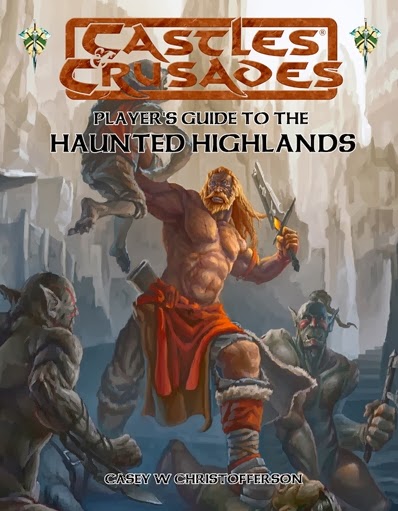
Weekend R&R: Player's Guide to the Haunted Highlands (C&C)

Last summer, Troll Lord Games launched a Kickstarter to promote the Haunted Highlands, an adventure setting for the Castles & Crusades RPG.  The brainchild of Casey Christofferson, the Haunted Highlands started off as a series of adventure modules published a few years for C&C, these have been pulled together along with an accessory called the Black Libram to from a portion of the two books to come out of this Kickstarter.  These are the Player's Guide to the Haunted Highlands and the Castle Keeper's Guide to the Haunted Highlands.


The Player's Guide to the Haunted Highlands

The book is a modest, 112 page book which basically gives an overview of the new races, new classes, and variants available in the setting as well as basic information about the Highlands.  In fact the first 28 pages is dedicated to the setting and the system specific 'crunch' doesn't begin to happen doesn't start before page 36.

The remainder of the book is clearly divided into 4 chapters though a 5th would have been warranted (and may possibly have been intended).  These are 'Creating the Character', 'Races of Karbosk', 'Character Classes', and 'Dual Classing'.

The first chapter after the overview is on 'Creating the Character' but this a bit of a misnomer.  Sure, it starts off by telling the would-be player to select their class, roll their attributes, and so on but most of the content of this chapter is devoted to an explanation of the attributes, the Siege Engine mechanic and how attribute checks, saving throws, and then how combat works.  The chapter goes so far to go into situational modifiers, combat maneuvers, and even other odds and ends such as Spell Resistance and Turning Undead.  This isn't a bad thing but none of this content is new; it's lifted straight out of the C&C PHB.  When I first heard that this material was going to be in the book, I had hoped that the Player's Guide would be 'self-sufficient' after a fashion.  I supposed it could be if you restricted yourself to the new races and classes there were in this book only.  That would also mean restricting yourself to the new spells listed here too.  However, given what's actually available to play in this book, the inclusion of this material doesn't make much sense, but who knows.

On the subject of races and classes, the second chapter covers what you need to play Orcs, Goblins, Hobgoblins, Dark Dwarves (the Zvarguth), and Meshkuri.  Given the typical nature of these races in your typical game, these may be atypical of the sort players would find themselves playing.  More often than not, I imagine it's the person who is running the game that tends to veto such an idea.  The Highlands are a bit darker and certainly harsher so these selections may not be so odd given the setting.  Variety is always interesting and most C&C fans will find these a welcome or at least interesting addition to the game.

Chapter 3 is all about new classes though in this section, two of the classes were previously published.  The first of these is the Conjurer which originally appeared in DB6 -Dwellers in the Dark.  Since these modules were being reprinted together in the CK Guide to the Haunted Highlands, it only makes sense to put it here.  The second of these is the Necromancer which appeared in the Black Libram of Natarus.  It's worth noting that the entirety of this accessory (now out of print) can be found in the pages of these two new Haunted Highland books.  Also included is a different and tougher Assassin class, a Witch class, as well as other class variants. 

Of interest to many C&C players who have their roots in older editions of D&D will be the rules provided for Dual Class characters.  In principal, the rules supplied are almost adequate though I find myself disagreeing with a couple of points.  Simply put and as I understand it, it's broken.

EDIT - I should point out that this is only my opinion and the following examples I provide are a bit extreme to illustrate a point given my understanding ... By no means does this mean it's unusable and I'm sure it would be fine in regular play.

Take what the author outlines for Base-to-Hit progression for example.  The argument is that you don't 'forget' how to fight and improvement and training in an on-going thing.  Any new BtH bonus acquired in the new class is gained as a result.  At first glance, this might make sense.  However, suppose a high level Fighter (say 10th) decides to become a Bard.  Once his apprenticeship is done with, he can begin advancing in his new class.  Keep in mind that the apprenticeship is half the requirement to reach level two in the new class.  If the average XP needed for the party is about 250,000 to reach level 11, the player who changed class to a Bard who decides to focus on advancing this class only can advance to level 9 as a Bard and effectively be a 19th level character when the rest of the party is 11th.  His BtH would be a 18 compared to the 11 of an 11th level fighter.

The other issue is nothing definite is given on the subject of Hit Dice and hit points except that you advance in the new class normally.  Does this mean that, after rolling 10d10 for hitpoints for those 10 levels of fighter taken, you would then keep on rolling d10 for every level of Bard taken (since you roll up to and including level 10 of any given class)?  Compare 19d10 vs the 11d10 of that simply 11th level fighter who has the same amount of XP.

It's problematic though it could easily be fixed.  Since other class abilities and skills are constrained by the class level itself (and not total level), the same MUST be done with the BtH bonus.  Total HD also need to be limited -- only 10 dice worth can be rolled up for HP and any HP gained after 10 HD is determined by the class the character advanced in.  I suppose that's the easiest way to fix it though Dual Classing in general is far from elegant in a variable XP/Class system.

Sadly, the book's organization becomes a bit muddled after the Dual Classing.  Chapter 4 seemingly continues into magic which, once again, is a repeat of material found in the PHB followed by new spells and a small section on sacrificial magic which were both originally found in the Black Libram.

It really seems like this last magic section should have been it's own chapter but somehow, it got lost in the editing and layout process.  On the subject of editing, along with some of the other things I have seen in this book, it does feel that it was rushed in parts of it.  In the first few pages when I stopped to examine a passage, I found a number of little issues.  I think some of these have to do with the parts of the text that were ported (copied and pasted) into the present book.  In passages that exist in the PHB, I have seen words 'thrust together' because of missing spaces in this book.  On the same page, I've seen another example of sentence starting off with the first word going uncapitalized.  These are very minor things but, it does give me pause to see several example of this on a single page of text that already exists in another book.  For those curious, please take a good look at the numbered page 41 of the book.  It is entirely possible that some of these 'space' issues are due to the program used for the layout of the book, or perhaps it was a slightly older version of the text that was used here.

Overall, I like the book and the companion CK book that comes with it (to be reviewed tomorrow, time permitting) looks to be great.  The book is far from perfect but perhaps it was the fact that a lot of the text in this book was seen before which led to a bit more complacency with regards to the integrity of the book.  Being the responsible sort that I am, I will attempt to point a few of these things out to the powers that be.  It hasn't gone to press yet so maybe a few of these things can be tweaked and the PDF updated.

For those wanting to grab a copy, it is available now (warts and all) at RPGNow over HERE.  It is priced as a MSRP of  $13.99 (cover price for the hardback will be $19.99 when available).